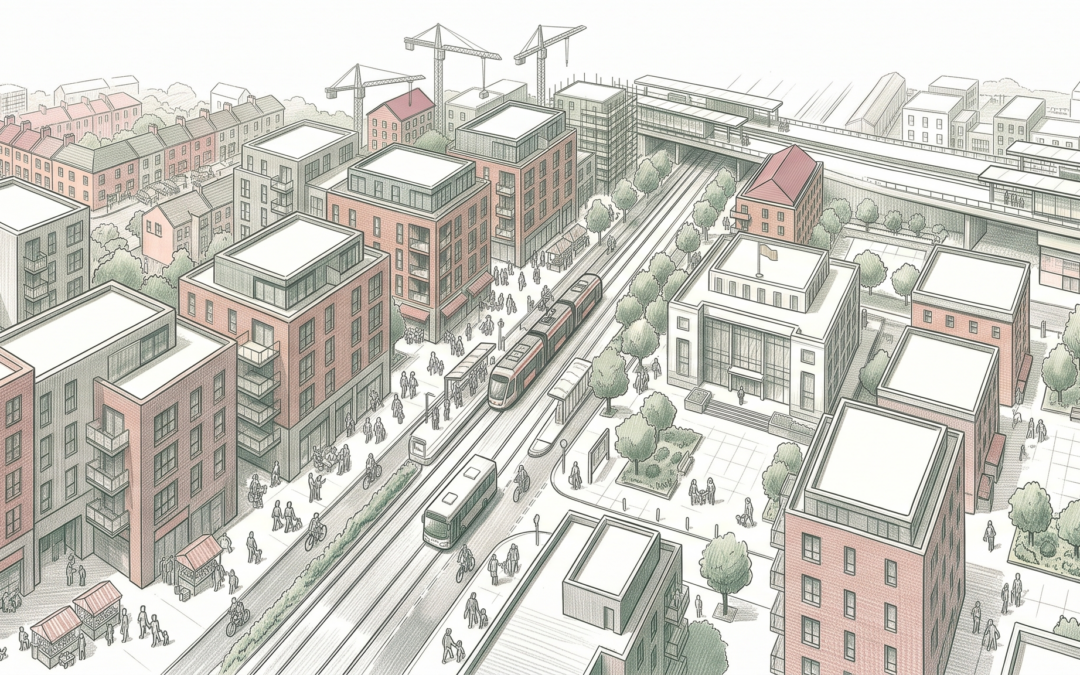
Many countries have a tool to acquire land to deliver the new homes, public transport, and community infrastructure that our cities and towns need. But Britain doesn’t use it, yet. Check out the first post in our series of upcoming pieces on land readjustment: a new devolved power for urban regeneration.
Learning from the Elizabeth line
The Elizabeth line is now the UK’s busiest railway line, but what made it succeed where other projects stalled? Key to the Elizabeth line’s success was land value capture: it clawed back some of the value it created, raising billions in funding through a business rate supplement and payments from developers along the route.
However, the Elizabeth line did not come easily. The Crossrail project needed its own Act of Parliament, and served more than 11,000 compulsory purchase notices to acquire more than 150 hectares, much of it in central London, from roughly 1,500 owners. This cost around £860 million. Even then it recovered only about a tenth of the rise in land values it had caused. Local people got a great railway in return, but the difficulties of pursuing land assembly without sufficient powers to do so meant negotiating plot by plot, while only capturing a small amount of land value for funding.
Breathing life back into our cities and towns
Many town and city centres across the country lack the good public transport links and new homes that local people want. But to regenerate urban areas, Mayoral Authorities will all face a similar challenge: how do you get the land together quickly, cheaply, and without extended legal battles against vested interests?
Greater Manchester is as good at tackling this as anywhere in the country. Its Combined Authority and its Mayoral Development Corporations are rebuilding brownfield sites and town centres at a transformative scale.
One powerful example is Stockport’s Mayoral Development Corporation, which is delivering the largest town centre regeneration in the UK. With its new transport interchange and 1,200 homes built or under way (out of 8,000 in total), Stockport is now widely regarded as Manchester’s most popular commuter town.


Assembling land on that scale means dealing with a lot of separate owners, and Greater Manchester has the compulsory purchase powers to do it. The stated aim is to buy by agreement wherever it can, and to make compulsory purchase a regeneration tool rather than a threat. This is because compulsory purchase is often conflictual: big landowners hold out until they get a large sum of money. Any compulsory purchase runs a high risk of judicial review, adding time and cost.
Manchester’s instinct to negotiate rather than compel is the same instinct that land readjustment, a new idea to the UK, draws on. But negotiating one by one with landowners is itself a lengthy and challenging process. Knowing their plot can block the whole project, individual landowners often hold out for more: just like Manchester United’s Old Trafford regeneration plans, held up by a single landowner demanding £350 million more than the offered price.
A fairer way: land readjustment
A fairer way does exist, and countries around the world have used it for more than a hundred years. Rather than forcibly acquiring land, readjustment pools lots of smaller plots into one large one. Then you redraw the whole thing: lay out the space the neighbourhood needs for roads, parks, drainage, and a station; and keep a slice back to sell to cover the bill. Everyone gets a plot returned, smaller than before but worth more, because it now has better infrastructure. As far as sensible, existing buildings are designed around.
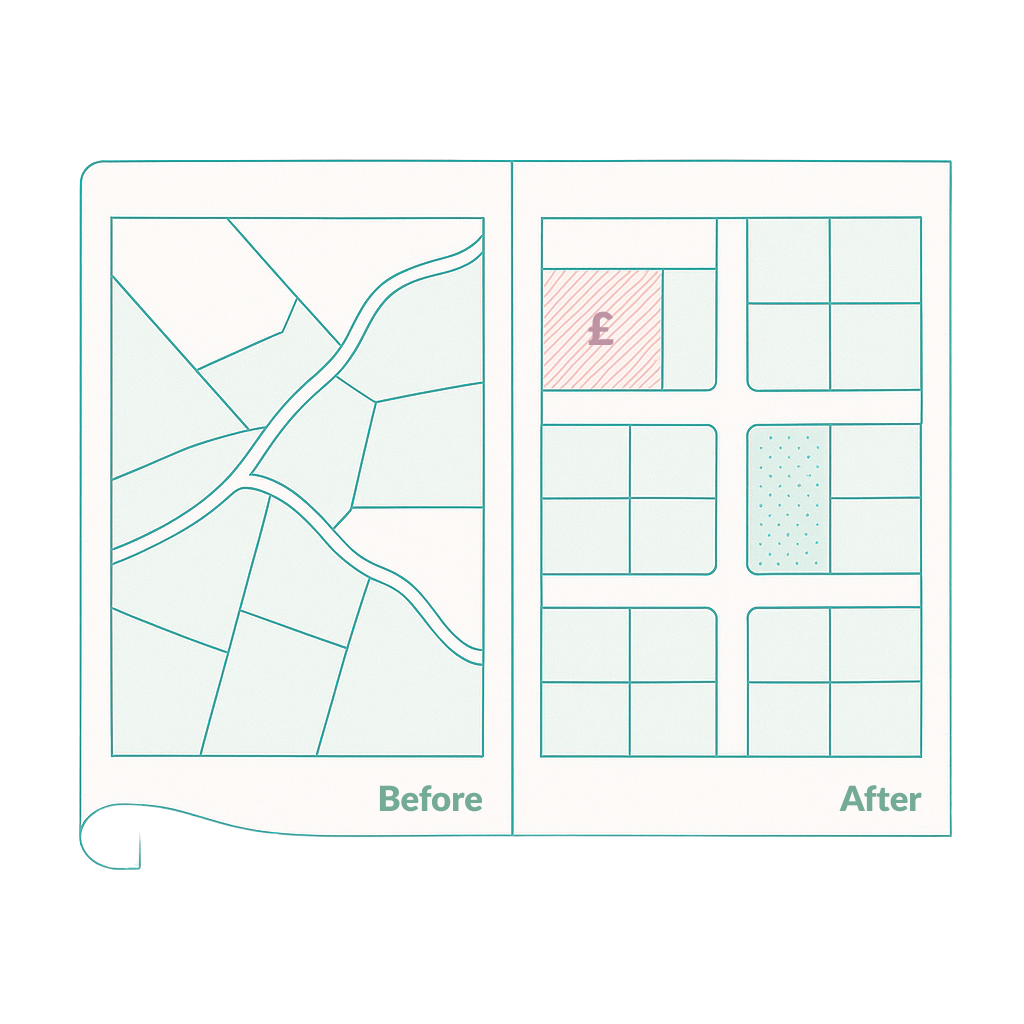
Nothing happens unless most of the owners vote for it, so change isn’t dropped on people from above, and a single holdout can’t sink the scheme. Residents can often stay put with a stake in their own patch instead of being paid off and shown the door. Everyone’s land rises by roughly the same proportion, so the money spreads around rather than becoming a windfall for one or two owners. And the infrastructure is paid for out of the value the scheme creates, not out of taxes.
Land readjustment around the world
Land readjustment started in Germany, in Frankfurt in 1902, and spread across the country by 1918. Germans have used it ever since to lay out orderly town extensions: in Baden-Württemberg it produced 84% of building plots across 350 municipalities in the 1980s.
Spain runs its own version, reparcelación. Barcelona used it to remake Poblenou, the derelict factory district, into the 22@ Innovation District: owners gave up part of their plots for new streets, services, and affordable homes in return for the right to build new offices and flats. The district has since drawn in thousands of firms, from Yahoo to Microsoft to Schneider Electric, and tens of thousands of jobs.
In Japan, land readjustment is known as the ‘mother of urban planning’. After the 1923 earthquake levelled much of Tokyo, the city used it to lay out its street network again from scratch, tram lines and all. Over the next century it reshaped around 30% of Japan’s urban land and produced some 12,500 kilometres of city roads, half the country’s local parks, and roughly 1,000 station squares. In a disaster-prone country, it has been a literal lifesaver, letting cities rebuild to higher earthquake-safety standards with clear routes for emergency vehicles.
Could it work here?
Many of the institutions we’d need already exist. Councils, the Combined and Mayoral Authorities, and Development Corporations already undertake ambitious regeneration projects.
The tools to grant permission across a whole area at once, such as Local Development Orders, are also widely used. While it would require an Act of Parliament to enable it, bringing land readjustment to Britain is mostly a matter of stitching together things we already have.
This would give Authorities like Greater Manchester an additional tool to pursue vital regeneration projects. It’d be optional, a route an authority could reach for when it suits. Where the affected residents and the Planning Authority both want it, a scheme that would otherwise stall can move.
Many countries worked out long ago that building new homes and improving public transport needn’t mean a fight over every plot. We should learn from international best-practice and empower Mayoral Authorities to deliver the regeneration projects they want. Give an authority like Greater Manchester the option of land readjustment, and the next major regeneration project can go ahead faster and with less conflict.
Stay tuned for our next post giving more detail about land readjustment!
Recent Comments